

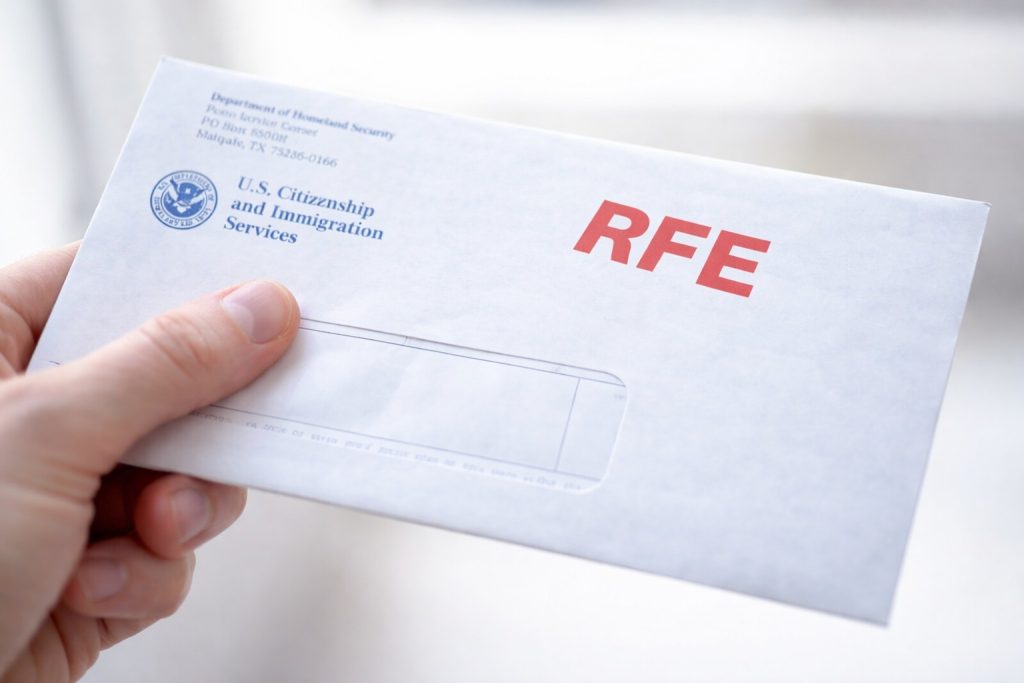
An RFE from USCIS (Request for Evidence) is an official notice asking for additional documents or clarification before an immigration petition or application can be approved. It does not automatically mean denial, but it does mean USCIS needs stronger proof to confirm eligibility. Responding correctly and on time is essential.
What Is an RFE From USCIS? (Clear Definition)
An RFE, or Request for Evidence, is a formal letter issued by the U.S. Citizenship and Immigration Services (USCIS) when the officer reviewing a case determines that the petition does not contain enough evidence to make a final decision.
In simple terms, USCIS is saying:
“We reviewed your case, but we need more information before we can approve or deny it.”
An RFE is common in many U.S. immigration processes and can occur in:
- Employment-based petitions
- Family-based petitions
- Student-related applications
- Adjustment of status filings
- Green card and visa-related cases
The key point is that USCIS is giving the applicant an opportunity to strengthen the case rather than denying it immediately.
Why USCIS Issues RFEs
USCIS issues an RFE when the submitted paperwork is incomplete, unclear, inconsistent, or not persuasive enough to meet the immigration requirement.
Common reasons USCIS sends an RFE include:
- Missing required documents
- Unclear eligibility proof
- Conflicting information between forms and supporting evidence
- Missing translations or certifications
- Weak evidence of education or work experience
- Lack of proof that a job qualifies as a specialty occupation
- Employer-employee relationship concerns
- Questions about degree equivalency
RFEs can range from simple requests (missing signature or missing page) to complex requests requiring detailed professional documentation.
Why an RFE Matters in U.S. Immigration, Employment, and Education
Even though an RFE is not a denial, it can significantly affect timelines and future decisions.
Immigration impact
An RFE usually pauses processing until USCIS receives and reviews the response. This can cause delays that may affect:
- Visa approvals
- Work authorization planning
- Status extension timing
- Petition deadlines
Employment impact
For employer-sponsored immigration, RFEs may disrupt:
- Hiring timelines
- Start dates
- Compliance documentation
- Business planning
Education impact
In education-based immigration matters, USCIS may request proof of academic equivalency or credential legitimacy, which can affect:
- Eligibility decisions
- Academic qualification confirmation
- Degree equivalency analysis
What an RFE Usually Contains
A USCIS RFE letter is typically structured and detailed. Most RFEs include:
- The case type and receipt number
- The issue USCIS identified
- A list of required evidence
- Instructions for submission
- A strict response deadline
- Mailing address for the response package
Important note:
USCIS RFEs are time-sensitive. If the deadline is missed, the case may be denied or rejected without further notice.
RFE vs Denial vs NOID
Many applicants confuse an RFE with other USCIS notices. Understanding the difference matters.
RFE (Request for Evidence)
- USCIS needs more proof
- Applicant has a chance to respond
- Case is still under review
NOID (Notice of Intent to Deny)
- USCIS believes the case may not qualify
- Stronger warning than an RFE
- Requires a very detailed response
Denial
- USCIS has already decided the case does not qualify
- Case is closed unless appealed or refiled
An RFE is generally a “fix it” opportunity, while a NOID is closer to a final warning.
Common Types of USCIS RFEs (Nationwide)
RFEs vary by petition type, but certain categories are extremely common across the U.S.
1. Education and Degree Equivalency RFEs
USCIS may question whether foreign education meets U.S. standards. This is especially common in employment-based petitions.
Typical issues include:
- Three-year bachelor’s degrees
- Missing transcripts
- Non-standard academic programs
- Lack of U.S. equivalency proof
This is where credential evaluation becomes important. A professional foreign credential evaluation report may help explain how international education compares to U.S. education.
Internal service page support: Foreign Credential Evaluation USA
2. Specialty Occupation RFEs
Common in professional work visa filings. USCIS may ask whether the job truly requires a bachelor’s degree in a specific field.
3. Employer-Employee Relationship RFEs
USCIS may request proof that:
- the employer controls the work
- the job is real and ongoing
- supervision and payroll structure exist
4. Work Experience and Job History RFEs
USCIS may request:
- employment letters
- pay records
- job duties evidence
- proof that work experience matches claimed skills
5. Documentation or Form Errors
These RFEs may occur due to:
- missing pages
- unclear copies
- inconsistent dates
- missing signatures
Common Misconceptions About USCIS RFEs
Many people misunderstand what an RFE means, which can lead to poor decisions.
Misconception #1: An RFE means my case will be denied.
Not necessarily. Many cases are approved after a proper RFE response.
Misconception #2: Any evidence is fine as long as I submit something.
USCIS expects the response to directly address each question in the RFE.
Misconception #3: I should send too many documents just to be safe.
Overloading the response with irrelevant paperwork can confuse the officer and weaken clarity.
Misconception #4: I can respond later if I’m busy.
Deadlines are strict. Late responses can lead to denial.
How USCIS Evaluates an RFE Response
USCIS officers review the response based on whether the evidence provided resolves the concerns listed in the notice.
USCIS typically looks for:
- Clear organization
- Proper labeling and indexing
- Consistency across documents
- Credible and verifiable proof
- Direct response to each question
- Professional explanations when needed
The response should be structured like a professional submission, not like a random file upload.
How This Connects to Credential Evaluation and Expert Opinion Letters
Many RFEs involve education, degree equivalency, and qualification concerns, especially when foreign education is involved.
Credential evaluation relevance
If USCIS questions whether a foreign degree is equivalent to a U.S. degree, a credential evaluation report may help clarify:
- degree level equivalency (Bachelor’s/Master’s)
- length of study
- academic institution recognition
- course content and specialization relevance
A properly prepared evaluation can reduce confusion and help USCIS understand the applicant’s educational background in U.S. terms.
You can learn more about credential evaluation services here:
Expert opinion letters relevance
Some RFEs require expert analysis, especially when:
- education does not follow standard U.S. patterns
- job requirements are specialized
- work experience is used to support qualification
Expert opinion letters are often used to explain technical or academic equivalency in a structured way.
When Professional Guidance May Be Appropriate
Not every RFE requires professional support. However, professional guidance may be helpful when:
- The RFE involves degree equivalency concerns
- The case includes foreign education documentation
- USCIS requests specialized evidence
- The petition has a prior denial history
- The RFE contains multiple complex questions
- There is a short deadline and high risk of error
In these situations, structured documentation and proper interpretation can reduce confusion and improve compliance.
Practical Tips for Responding to a USCIS RFE (Non-Legal Guidance)
Here are practical steps that can improve clarity and reduce avoidable mistakes.
1. Read the RFE carefully multiple times
Highlight exactly what USCIS is asking for. Do not guess.
2. Organize your response like a professional packet
Include:
- cover letter
- table of contents
- labeled evidence sections
- supporting documents in order
3. Respond to every item listed
If USCIS asks for 5 items, provide a response for all 5.
4. Avoid irrelevant evidence
Only include what supports the request.
5. Use clear copies and certified translations
Unclear scans or unofficial translations can cause rejection.
6. Keep everything consistent
Dates, job titles, academic years, and names must match across all documents.
7. Mail using trackable delivery
Always keep proof of delivery and a full copy of your response package.
Frequently Asked Questions (AEO-Focused)
1. What is an RFE from USCIS?
An RFE from USCIS is a Request for Evidence, meaning USCIS needs additional documents or clarification before deciding on an immigration petition. It does not automatically mean denial, but it must be answered correctly and before the deadline to avoid negative outcomes.
2. Does receiving an RFE mean my case will be denied?
No. An RFE means USCIS needs more proof to make a decision. Many cases are approved after a proper response. The final outcome depends on whether the evidence submitted resolves the concerns listed in the RFE notice.
3. How long do I have to respond to a USCIS RFE?
USCIS provides a specific response deadline printed on the RFE notice. Deadlines vary depending on case type. Missing the deadline may result in denial or rejection, so it is important to respond early and submit complete documentation.
4. What happens if I respond late to an RFE?
If the RFE response is late, USCIS may deny the petition or decide the case using only the evidence already submitted. In most situations, USCIS does not accept late responses unless specific exceptions apply, so timely submission is critical.
5. What documents are commonly requested in an RFE?
USCIS may request education documents, transcripts, employer letters, job duty details, proof of work experience, financial evidence, or identity records. The request depends on the petition type. Many RFEs focus on eligibility proof and consistency of supporting documentation.
6. Can foreign credential evaluation help with an RFE?
Yes, in cases where USCIS questions foreign education equivalency, a credential evaluation may help clarify how the degree compares to U.S. standards. It can strengthen evidence for education-based eligibility, especially in employment-related petitions and specialty occupation reviews.
7. What is the difference between an RFE and a NOID?
An RFE asks for more evidence before USCIS makes a decision. A NOID (Notice of Intent to Deny) indicates USCIS is leaning toward denial unless strong evidence is provided. A NOID is typically more serious and requires a stronger response strategy.
8. Should I get professional help for an RFE?
Professional guidance may be appropriate when the RFE is complex, involves foreign education equivalency, includes multiple issues, or follows a prior denial. While not always required, structured and accurate responses can reduce mistakes and improve clarity for USCIS review.
Final Thoughts
A USCIS RFE can feel stressful, but it is often a normal part of the immigration review process. The most important step is responding carefully, clearly, and with properly organized supporting evidence. If you’re unsure how the RFE applies to your education or documentation, a confidential review can help clarify your options before taking next steps.
About Sheila Danzig
Sheila Danzig is the executive director of TheDegreePeople.com and a leading expert in foreign degree evaluations. She is widely recognized for her innovative approach to difficult cases, helping thousands of clients successfully obtain visa approvals even when facing RFEs or denials. Her expertise in USCIS requirements and commitment to providing personalized, effective solutions make her a trusted resource for professionals navigating the immigration process.
Get a Free Review of Your Case
If you’ve received an RFE, don’t wait. Sheila Danzig and TheDegreePeople.com offer a free review of your case to determine the best course of action. Our expertise has helped thousands of professionals, including H-1B applicants, secure approvals even in challenging cases.
To get your free case review, visit www.ccifree.com today.