

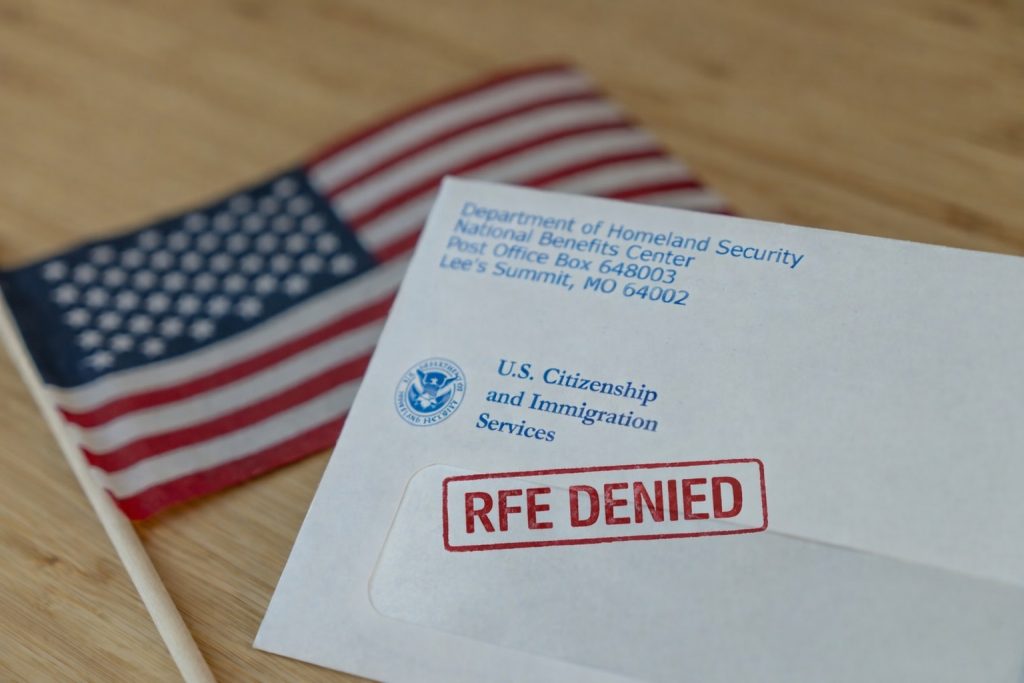
Yes, an RFE (Request for Evidence) can lead to a denial if USCIS determines that the response does not provide enough evidence to meet eligibility requirements. An RFE itself is not a denial, but it is a formal warning that USCIS needs stronger documentation before approving a petition. A late, incomplete, or unclear response may result in rejection or denial.
What Does an RFE Mean in U.S. Immigration?
An RFE (Request for Evidence) is an official notice issued by U.S. Citizenship and Immigration Services (USCIS) when an immigration officer reviewing a case believes the petition does not contain enough information to approve it.
USCIS issues an RFE to request:
- Missing documents
- Clarification of submitted evidence
- Additional proof of eligibility
- Corrected or updated supporting records
RFEs are common in many immigration processes, including employment-based petitions, family-based cases, adjustment of status applications, and visa extensions.
An RFE means USCIS is still reviewing the case but cannot make a final decision without more evidence.
Can an RFE Be Denied?
An RFE itself cannot be “denied” because it is not an application. However, the case connected to the RFE can be denied if USCIS is not satisfied with the response.
USCIS may deny a petition after an RFE if:
- The response is not submitted by the deadline
- The evidence is incomplete or irrelevant
- The response does not directly answer USCIS concerns
- The officer concludes eligibility requirements are not met
In many cases, USCIS issues an RFE because the case is potentially approvable, but only if stronger proof is provided.
Why USCIS Denies Cases After an RFE
1. Failure to Respond on Time
USCIS RFE notices include a strict deadline. If the response is late, USCIS may deny the petition automatically.
Even if evidence is strong, missing the deadline can result in denial.
2. Submitting the Wrong Evidence
A common mistake is sending general documents that do not address the exact request.
USCIS officers expect direct evidence, not unrelated paperwork.
3. Inconsistencies in the Response
USCIS may deny if new evidence contradicts the original filing.
Examples include:
- Different job duties than originally stated
- Different degree completion dates
- Conflicting employer details
- Inconsistent work experience history
4. Weak Documentation or Unclear Proof
USCIS may deny if the evidence is unclear, incomplete, or not credible.
For example:
- Unclear scans
- Unofficial transcripts
- Missing certifications
- Unsupported claims
5. Eligibility Requirements Are Not Met
Some RFEs are issued when USCIS suspects the applicant may not qualify. If the response confirms that the requirements are not met, denial may follow.
Why This Matters in U.S. Immigration, Employment, and Education
RFE-related denials can have serious consequences beyond one case.
Immigration consequences
A denial may lead to:
- Delayed immigration plans
- Loss of filing fees
- Additional evidence burdens in future filings
- Difficulty in future petition approvals
Employment consequences
Employment-based petitions often affect:
- work authorization timelines
- employer onboarding schedules
- company compliance planning
- contract or project timelines
Education-related consequences
For education-based eligibility issues, a denial may occur if USCIS believes:
- the foreign degree is not equivalent
- the education does not match the job specialty
- transcripts do not support the claimed qualification
Because education evidence is commonly reviewed in immigration filings, documentation must be accurate and professionally presented.
Common Misconceptions About RFEs and Denials
Misconception #1: “Getting an RFE means approval is coming.”
Not necessarily. An RFE means USCIS needs more proof. Approval depends entirely on how well the response resolves the issue.
Misconception #2: “Any response is better than no response.”
A weak or incomplete response may still lead to denial. USCIS expects a complete answer.
Misconception #3: “If I send a large amount of documents, I will be safe.”
Sending too many irrelevant documents may confuse the officer. Clear, focused evidence is more effective.
Misconception #4: “USCIS will send another RFE if something is missing.”
USCIS is not required to send multiple RFEs. If your response is incomplete, USCIS may deny without further notice.
How USCIS Evaluates an RFE Response
USCIS reviews an RFE response using a straightforward approach:
USCIS checks whether:
- Every requested item is addressed
- The documents are credible and verifiable
- Evidence supports the legal eligibility requirement
- The petition remains consistent
- The explanation is clear and professionally organized
USCIS officers typically prefer responses that are:
- structured
- indexed
- clearly labeled
- supported with strong documentation
Even when evidence exists, a poorly organized response can lead to misunderstandings.
Common Situations Where USCIS Denies After an RFE
Many denials occur in specific categories of RFEs.
Education or Degree Equivalency RFEs
USCIS may question:
- whether the foreign degree equals a U.S. degree
- whether the degree matches the specialty occupation
- whether the academic program is valid and recognized
In these cases, a foreign credential evaluation or expert review may help clarify equivalency.
Specialty Occupation RFEs
USCIS may deny if it believes the job does not require a specialized degree.
Employer-Employee Relationship RFEs
Denial may occur if USCIS believes the job role is unclear, temporary, or lacks employer supervision evidence.
Work Experience RFEs
Denials can happen if:
- experience letters are vague
- job duties are unclear
- documentation is not credible
How This Connects to Credential Evaluation and Expert Opinion Letters
Many RFEs involve questions about foreign education or qualifications. USCIS may require evidence that clearly explains:
- U.S. degree equivalency
- academic specialization
- whether education matches the offered job
- whether experience supports the role
Credential evaluation relevance
Credential evaluation reports can help USCIS understand foreign degrees in U.S. terms, especially in employment-based cases.
Expert opinion letter relevance
Expert opinion letters may help explain complex education and experience combinations, including technical or specialized career backgrounds.
RFE support relevance
A professional RFE response often includes:
- structured cover letter
- clear exhibits
- evidence mapping to each USCIS request
- supporting evaluation reports
When Professional Guidance May Be Appropriate
Not every RFE requires professional help. However, professional review may be appropriate when:
- the RFE is complex or has multiple issues
- the case involves foreign education equivalency
- USCIS questions specialty occupation requirements
- the case has a prior denial history
- the response deadline is short
- the evidence requires expert explanation
In these situations, structured documentation and accurate interpretation can reduce avoidable mistakes.
Practical Tips to Strengthen H-1B Education Documentation (Non-Legal Advice)
Here are practical, compliance-focused steps that can improve response quality:
1. Respond to Every Item in the RFE
Create a checklist and ensure nothing is skipped.
2. Include the RFE Notice on Top
USCIS expects the original RFE letter included in the response packet.
3. Write a Clear Cover Letter
A good cover letter should:
- summarize the issue
- list all evidence included
- map each evidence item to each USCIS request
4. Use Organized Exhibits
Label documents clearly:
- Exhibit A
- Exhibit B
- Exhibit C
5. Avoid Contradicting Your Original Filing
New evidence should strengthen your case, not create new inconsistencies.
6. Submit High-Quality Copies and Translations
Poor scans and unofficial translations can weaken credibility.
7. Send Your Response Early
Avoid last-minute delivery risks and allow time for final review.
FAQ: Can an RFE Be Denied?
1. Can an RFE lead to a denial?
Yes. While an RFE itself is not a denial, USCIS can deny the petition if the response does not provide sufficient evidence. Denials often happen when the response is incomplete, inconsistent, submitted late, or fails to address USCIS’s specific concerns listed in the RFE notice.
2. What happens if I don’t respond to an RFE?
If you do not respond to an RFE, USCIS will usually decide the case based on the original submission, which often results in denial. USCIS provides the RFE as an opportunity to correct missing or unclear evidence. Missing the deadline is one of the most common reasons for denial.
3. Does an RFE mean USCIS will approve my case?
No. An RFE means USCIS needs more documentation before making a decision. Approval depends on the quality and completeness of your response. If USCIS remains unconvinced after reviewing the response, it may deny the petition even after receiving additional evidence.
4. Can USCIS deny a case even after I submit the RFE response?
Yes. USCIS can deny a case if the evidence submitted does not meet eligibility requirements. Even if you submit documents, USCIS may still deny if the response is weak, unclear, irrelevant, or inconsistent with the original petition. Strong organization and direct evidence are important.
5. How often are RFEs denied?
USCIS does not publicly deny all RFEs at a fixed rate because outcomes depend on case type and evidence quality. Many RFEs are resolved successfully, but denials occur when eligibility cannot be proven. Proper documentation, clear organization, and timely submission reduce denial risk.
6. Can an RFE response be rejected for being incomplete?
Yes. If the RFE response does not address all requested items, USCIS may treat the response as insufficient and deny the petition. USCIS is not required to issue another RFE. Each request must be answered directly, with supporting documents clearly labeled and organized.
7. Can a credential evaluation help prevent denial after an RFE?
Yes, in cases where USCIS questions foreign education equivalency. A credential evaluation may help clarify how a foreign degree compares to U.S. standards. If education is a key eligibility factor, a professional evaluation report can strengthen the response and improve clarity for USCIS review.
8. What should I do if my case is denied after an RFE?
If a case is denied after an RFE, the next steps depend on the reason for denial. Some cases may allow refiling, appeals, or motions, while others may require corrected documentation. Reviewing the denial notice carefully is important to understand what evidence USCIS found insufficient.
Final Thoughts
An RFE is a serious notice, but it is also an opportunity to strengthen your case before USCIS makes a final decision. Denials after an RFE typically occur when evidence is incomplete, unclear, inconsistent, or submitted late. If you are uncertain how to respond or how the RFE affects your eligibility, a confidential review can help clarify your options before taking next steps.
For more information related to RFE and denial support, you may visit:
https://www.thedegreepeople.com/rfe-denials-support/
About Sheila Danzig
Sheila Danzig is the executive director of TheDegreePeople.com and a leading expert in foreign degree evaluations. She is widely recognized for her innovative approach to difficult cases, helping thousands of clients successfully obtain visa approvals even when facing RFEs or denials. Her expertise in USCIS requirements and commitment to providing personalized, effective solutions make her a trusted resource for professionals navigating the immigration process.
Get a Free Review of Your Case
If you’ve received an RFE, don’t wait. Sheila Danzig and TheDegreePeople.com offer a free review of your case to determine the best course of action. Our expertise has helped thousands of professionals, including H-1B applicants, secure approvals even in challenging cases.
To get your free case review, visit www.ccifree.com today.